
Wind takes the shingles off in ten minutes. The part that takes months is everything that comes afterwards — the adjuster's estimate, the check that arrives with your mortgage company's name printed on it alongside yours, the contractor who wants a deposit before the money is released, and the slowly dawning realization that you are living in a repair project you never asked for.
Dayton knows this better than most places its size. On the night of May 27, 2019 the National Weather Service office in Wilmington confirmed 19 tornadoes across the region, the strongest an EF4 that touched down at 10:41 pm and tracked through Brookville, Trotwood, Dayton and Riverside before it lifted 32 minutes later. Straight-line wind and hail events since have been less dramatic and far more routine. Between them, a large number of houses in Montgomery County have an open claim, a half-finished repair, or a settlement that was spent on something more urgent than the roof.
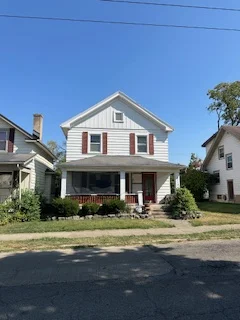
A Dayton house we bought in the condition it was in. The full before-and-after is on our Dayton project write-up.
This guide is about selling a house in that state: how the insurance money actually moves, what you forfeit by selling before you repair, the property-tax relief most damaged owners in Montgomery County never claim, what Ohio requires you to disclose, and the three realistic paths out.
Why the Insurance Check Has Your Lender's Name On It
The first surprise for most homeowners is that the settlement check is not theirs to deposit. If there is a mortgage on the house, the lender has an insurable interest in it, and the standard mortgage clause in your policy means major property-damage payments are issued jointly to you and your servicer. You endorse it, and it goes to a department most people have never heard of until this moment: loss drafts.
How the Loss Draft Account Works
The servicer deposits the money into a restricted account and releases it in stages as the work is done. In practice that means an adjuster's estimate and a signed contractor agreement up front, then a first draw so the work can start, then inspections at agreed milestones before the remaining draws are released, and a final inspection before the balance is paid out. Servicers set their own thresholds for how much they will simply endorse and hand over versus how much they will monitor, and those thresholds are policy, not law — ask yours for its written loss-draft requirements in the first week rather than the sixth.
What Actually Slows It Down
Three things, almost always. A contractor who will not provide a W-9 or a lien waiver. An inspection that gets scheduled two weeks out because every adjuster and inspector in the Miami Valley is busy at the same time after a regional storm. And a loan that is behind — if you are delinquent, a servicer will often apply proceeds to the loan balance rather than release them for repairs, which is a nasty discovery to make when you were counting on that money to fix the roof. If your mortgage is already in trouble, read our guide to stopping foreclosure in Dayton before you assume the claim money solves it.
ACV, RCV, and the Money You Lose by Selling Unrepaired
This is the single most expensive thing to misunderstand, and it decides whether selling before you repair makes sense.
Most homeowners policies in Ohio are written on a replacement-cost basis, but they do not pay replacement cost up front. The first payment is generally actual cash value — the cost to replace the damaged item minus depreciation for its age and wear. The difference between that and the full replacement cost is held back. It is called recoverable depreciation, and under most replacement-cost policies you only recover it after the work is genuinely completed and you have submitted the invoices proving it.
The Consequence Nobody Mentions
If you sell the house without doing the repairs, you generally keep the actual cash value payment and lose the holdback, because the condition that releases it never happens. On a fifteen-year-old roof that gap can be a large share of the total claim. Two practical implications follow. First, "I will just sell it and pocket the insurance money" is usually worth less than people assume. Second, if you are going to sell as-is anyway, the honest comparison is between the cash-value payment plus the as-is sale price, versus the full claim plus a repaired sale price minus months of carrying costs, your deductible, and the risk of the repair going sideways. Read your own policy's loss-settlement section, or ask your agent to read it to you, before you decide.
Can You Sell a Dayton House With an Open Claim?
Yes, and it happens regularly. What it requires is that everyone agrees in advance where the money goes, because the claim and the house are two separate assets that both have your lender's fingerprints on them.
There are three workable versions. You settle the claim, keep the proceeds, and sell the house in its damaged condition at a price that reflects it — the cleanest, and the one buyers price most predictably. You assign the claim proceeds to the buyer as part of the purchase agreement, which needs the insurer's cooperation and explicit contract language rather than a handshake. Or the claim closes out entirely and the sale proceeds separately.
What does not work is leaving it vague. The title company handling your Montgomery County closing will pay off the mortgage from the sale proceeds, and any funds still sitting in a loss-draft account get resolved against that payoff — so an unaddressed claim turns into a delay at the closing table. Tell the title company about the open claim at the start. Our comparison of your selling options side by side is a useful way to frame which of the three actually fits your situation.
The Property-Tax Reduction Most Damaged Owners Never Claim
Here is a piece of Ohio law that is worth real money and is genuinely under-used. Under Ohio Revised Code section 319.38, the owner of property that has been injured or destroyed can apply to the county auditor for a deduction from taxable value reflecting the damage. You are not paying full-value taxes on a house with a hole in it, if you file.
How much you get back depends on which calendar quarter the damage happened in. The auditor first judges what fairly represents the extent of the injury, then deducts that full amount for first-quarter damage, 75 percent of it for the second quarter, 50 percent for the third, and 25 percent for the fourth. There is a floor: the statute allows no deduction where the damage amounts to less than one hundred dollars.
The deadlines are the part that bites, and they are not the same for every quarter:
- Damage in the first, second or third quarter — file by December 31 of the year the damage occurred.
- Damage in the fourth quarter — file by January 31 of the following year.
The form is DTE 26, the Application for Valuation Deduction for Destroyed or Damaged Real Property, and it goes to the Montgomery County Auditor, whose office can be reached at (937) 225-4326. Neighboring counties run the same statutory program through their own auditors, so a Greene, Miami or Clark County property files with that county instead. Miss the date and you have waived that year.
If your house was damaged this year and you have not filed a DTE 26, that is the single highest-value phone call on this page — and it is worth making whether you sell or not.
What Ohio Requires You to Disclose
Ohio Revised Code section 5302.30 requires sellers of most residential property of one to four units to give the buyer a completed residential property disclosure form. The statute specifically directs that form at the condition of the structure, including the roof, foundation, walls and floors, and at any material defects within your actual knowledge. The standard is good faith and honesty in fact — you disclose what you know, not what a professional inspection might eventually turn up.
For a storm-damaged house that cuts both ways, and the way people get into trouble is by treating repaired damage as though it never happened. If the roof was replaced after a hail claim, that is knowledge you have. If a tree came through the back bedroom and the framing was rebuilt, that is knowledge you have. Disclosing it is protective: a documented repair with an invoice behind it reassures a buyer, while a repair the buyer discovers themselves after closing looks like concealment. Our guide to selling a house as-is in Dayton covers how disclosure and as-is language interact, because as-is is not a substitute for telling the truth.
The Claim Follows the House, Not Just You
Insurers report paid claims to a shared database — the Comprehensive Loss Underwriting Exchange, run by LexisNexis, which the Consumer Financial Protection Bureau lists among the consumer reporting companies. A property's claim history sits in there for years, and your buyer's insurer will pull it when they quote.
That matters more than most sellers expect. A house with repeated water or wind claims can be quoted at a higher premium, or occasionally struggle to place standard coverage at all — and a buyer who cannot get affordable insurance cannot get a mortgage. Because it is a consumer report, the Fair Credit Reporting Act entitles you to a free copy about your own property every twelve months through the LexisNexis consumer disclosure service, and to dispute anything in it that is wrong. If you are heading into a listing on a house with a claim history, it is worth knowing what the buyer's insurer is about to read.
Storm Chasers, Public Adjusters, and Who Is Actually Licensed
Every significant weather event in the Miami Valley is followed by door-knocking. Some of those callers are legitimate local roofers with more work than they can handle. Some are not, and the pattern is consistent: an offer to "handle the whole claim for you," pressure to sign something on the doorstep, a request for a deposit before any work begins, and an out-of-area phone number.
The line worth knowing is this one. Under Ohio Revised Code section 3951.02, nobody may act as a public insurance adjuster in Ohio — or take compensation for adjusting your claim — without a certificate of authority from the Superintendent of Insurance. Those who hold one are styled certified public insurance adjusters, and the Ohio Department of Insurance runs a public license lookup you can check in a couple of minutes. A contractor who is negotiating your claim for a share of it, without that certificate, is doing something the statute does not allow.
The Department's consumer hotline is 1-800-686-1526, and its fraud and enforcement line is 1-800-686-1527. Both are free calls, and both are considerably cheaper than the alternative.
What It Costs to Close in Montgomery County
Whatever route you take, the transaction costs are the same and they are modest — but they are set at county level, and people budget them wrong.
| Item | Montgomery County | Who usually pays |
|---|---|---|
| Conveyance fee | $3 per $1,000 of the actual sale price | Customarily the seller |
| Transfer fee | $0.50 per parcel transferred | Customarily the seller |
| Real estate taxes | Billed a year in arrears — prorated at closing | Seller credits the buyer for their ownership period |
| Agent commission | Negotiated; none on a direct sale | Seller, when listing |
Those conveyance and transfer figures are the Montgomery County Auditor's published amounts; rates are set locally and differ across the region, so confirm with the relevant auditor if the house is in Greene, Clark or Warren County. And if there is a delinquent balance sitting on the parcel it comes out of the proceeds at closing — our guide to being behind on Dayton property taxes explains how those balances behave.
Your Three Realistic Options
1. Repair It, Then List It
The right call when the claim is generous relative to the damage, the contractor is booked and reliable, and you can carry the house through the work. A properly repaired house with documentation sells on the open market like any other, and the 2026 Dayton market picture is reasonable for move-in-ready stock in the stronger submarkets. The risks are schedule and scope: storm-season contractor availability in the Miami Valley is genuinely constrained, and opened walls have a way of revealing more than the estimate covered.
2. List It Damaged
Possible, but understand who your buyer is. Financed buyers are the problem: FHA and VA appraisers flag active roof leaks, structural damage and unrepaired storm damage, and conventional lenders often require repairs before closing. That narrows the field to cash buyers and renovation-loan buyers, and it usually means a price negotiation shaped by whichever repair bid the buyer's contractor produces — a bid you do not control. Deals in this lane fall through at inspection more often than sellers expect.
3. Sell As-Is for Cash
The right call when the repair timeline does not fit your life, when the loss-draft process has stalled, when the house is empty and costing you money every month, or when the shortfall between the settlement and the real repair cost is coming out of your own pocket. You trade some price for certainty and speed. It is the same calculus we set out in cash buyer versus realtor in Dayton, with one addition: on a damaged house, the carrying cost while you wait is real, and an empty house has its own meter running.
Selling to Us With Damage on the House
We buy houses in the condition they are in, and storm damage is squarely within that. Practically, on a damaged property, three things are usually worth saying out loud.
We do not need the repairs done, and we do not need the claim finished before we make an offer — but tell us where the claim stands, because who keeps the settlement is a term of the deal and it belongs in the conversation on day one rather than a week before closing. We do not need the house cleaned out or the utilities restored. And we buy across Montgomery County and the surrounding communities, so a damaged house in Dayton, Trotwood, Riverside, Huber Heights or Brookville is ordinary work for us rather than an exception.
If you want the fuller picture of how a direct sale runs, our as-is selling page walks through it, and the FAQ answers the questions that come up most often.