
Almost nobody sets out to own an empty house. It happens by accumulation. A parent passes and the estate takes longer than anyone expected. A tenant moves out and the turn keeps getting postponed. A job moves you to another state and the plan to fix the place up and list it next spring quietly becomes the plan to do it the spring after that.
Meanwhile the house is doing something you cannot see from out of state or across town: it is generating obligations. Some of them are ordinary and predictable — taxes, insurance, utilities. Others are specific to Dayton and Montgomery County, they compound, and several of them attach to the parcel itself rather than to you, which means they follow the property all the way to the closing table.
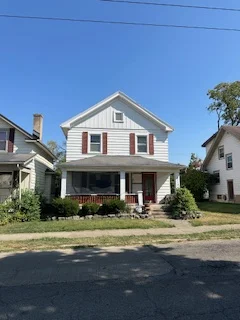
A Dayton home we purchased from an owner working through a financial hardship, photographed before we renovated it. The full write-up is on our Dayton financial hardship project page.
This guide walks through what actually happens to a vacant house in the City of Dayton — how the city learns it is empty, what enforcement looks like, how unpaid abatement work turns into a lien, what your insurance probably does and does not cover, and the faster foreclosure track Ohio law opens up for abandoned parcels. Then it lays out your four realistic options, including the ones that do not involve selling.
Why a Vacant Dayton House Gets Expensive Faster Than You Expect
An occupied house has a built-in early-warning system. Somebody notices the drip, the smell, the branch on the roof, the kicked-in basement window. An empty house has none of that, so small problems get months of uninterrupted time to become large ones.
The financial side works the same way. Almost every cost of ownership continues while the house sits, and a few get worse specifically because it is sitting:
| Cost | Still owed while vacant? | What changes when nobody lives there |
|---|---|---|
| Property taxes | Yes, in full | Nothing changes — but no one is opening the mail, so delinquency is often discovered late |
| Homeowners insurance | Premium yes; coverage often narrows | Vacancy clauses can limit or exclude losses such as vandalism and water damage |
| Utilities | Only if kept on | Shutting them off saves money but is what most often kills a financed sale later |
| Lawn, gutters, snow | Yes | Becomes a code-enforcement issue rather than a chore, and the city can do the work and bill you |
| Deterioration | Yes | Frozen pipes, roof leaks and pest entry compound unobserved, month over month |
| Mortgage, if any | Yes | Nothing changes, except there is no rent or occupancy offsetting it |
None of that is unique to Dayton. What follows is.
How Dayton Finds Out Your House Is Empty
Owners are often surprised that the city knows. It is not surveillance — it is that vacancy announces itself, usually through the yard.
Grass that has not been cut, a mailbox that is overflowing, trash or debris that accumulates, gutters coming loose, a porch that is starting to sag. Every one of those is visible from the street, and every one of them is the kind of thing a neighbor reports. Dayton also maintains a public housing tracker and a housing inspection division, and complaints from an adjacent property owner are one of the most common entry points into the enforcement process.
There is a second route worth understanding, because people confuse the two. Dayton runs a separate Use Nuisance Abatement Program, and it is not about vacancy at all. A property can be referred into that program only by the police, and only on evidence of specific illegal activity — drugs, gambling, illegal liquor sales, or prostitution. Anyone served with notice under that program has 15 calendar days to file an appeal, and once an appeal is filed a hearing is scheduled within 30 days. Vacant houses sometimes attract that kind of activity, which is the real connection, but an empty house is not referred to the Use Nuisance program simply for being empty.
The Civil Housing Enforcement Process, Step by Step
Dayton moved much of its housing code enforcement to a civil process rather than a criminal one, and the stated goal is compliance rather than revenue. That distinction matters to you, because it means the first contact is usually a warning with a cure period rather than a fine.
What Triggers It
Penalty warnings and citations get issued for exactly the conditions a vacant house tends to develop — overgrown vegetation, trash or debris in the yard, and exterior maintenance problems. Citations are issued by housing division conservation specialists and by the city's zoning administrator.
The Sequence
- A first-time violation, on a property with no prior issue in the past 12 months, generally brings a civil penalty warning notice rather than an immediate fine.
- That warning carries a 10-day window to correct the condition without penalty.
- If it is not corrected — or if the property has a recent history — a civil citation follows.
- Anyone cited may request an administrative hearing to contest the citation or to seek a reduction in the fine.
- If the condition still is not corrected, the city can abate it itself. That is where this stops being a fine and starts being a lien.
The practical problem for an out-of-town owner is step one. The warning notice goes to the address of record. If that address is stale, or if the mail is going to an empty house, the 10-day cure window can expire before you know it opened. If you own a vacant Dayton property and you do not live locally, make sure the county auditor has a current mailing address for you and put someone's eyes on the property monthly. Dayton Housing Inspection can be reached at (937) 333-3977 if you want to ask about a specific parcel.
When the City Does the Work and Bills You
This is the part that catches sellers at the closing table, and it is worth understanding precisely.
Under Ohio Revised Code § 715.261, when a municipality abates a nuisance — mows the lot, hauls the debris, boards the openings, secures the structure — it may certify the total cost of each abatement activity, along with the parcel number, the date the cost was incurred, and the name of the owner of record at that time, to the county auditor. The auditor then places that cost as a charge upon the tax list and duplicate.
Three consequences follow from that single sentence of statute:
- The charge is a lien upon the land from and after the date the cost was incurred — not from the date you were notified, and not from the date you were billed.
- It is collected as other taxes are collected, which means it rides along with your property tax bill and behaves like tax debt.
- Because it is a lien on the parcel, it must be resolved before clear title can transfer. It comes out of your proceeds when you sell, whether or not you ever agreed to the work.
A mowing you never authorized and a board-up you never saw are, by the time you sell, simply part of what the parcel owes. The cheapest version of this problem is the one you head off by cutting the grass.
If the parcel is also carrying unpaid taxes, these charges stack on top of a balance that is already growing. Our guide to being behind on property taxes in Dayton walks through that side of the ledger — the penalty, the interest dates, and the certificate sale — and our tax lien situation page covers what selling looks like when liens are already attached.
Vacant Property Registration — Who Actually Has to Register
Dayton has a vacant property registration ordinance, and there is a persistent misunderstanding about who it targets.
The registry began in the fall of 2013 as a pilot covering the six zip codes with the heaviest concentrations of vacant and foreclosed homes, and city commissioners later approved expanding it citywide. Its core requirement falls on mortgagees — banks and lenders with properties in foreclosure, or lender-owned REO properties, that sit vacant in the City of Dayton. They are required to register promptly, which means paying a fee and providing the name and contact information for their local agent, and failing to do so exposes them to civil penalties and late fees.
Why this matters to you as an individual owner: if your house is vacant and in foreclosure, the registration obligation sits with your lender, not with you. But the registry is also how the city builds its picture of which structures are empty. A property that lands on it is a property the city is tracking. Fees and requirements change, so confirm the current version directly with the city rather than relying on a summary — including this one.
Your Insurance Is Probably Not What You Think It Is
Of everything in this article, this is the item owners most often get wrong, and the one with the largest downside.
Most standard homeowners policies contain a vacancy or unoccupancy clause. Once a property has been unoccupied beyond a period stated in the policy, the carrier may limit or exclude certain losses — vandalism and water damage are the two that come up most often, and those are precisely the two that empty houses suffer. The length of that period and the list of excluded perils vary by carrier and by policy form, so there is no universal number to quote you. The number that governs your house is in your own declarations page.
Do this today rather than eventually: call your agent, say plainly that the house is unoccupied and for how long, and ask whether you need a vacant-property policy or a vacancy endorsement. Owners frequently discover that they have been paying premiums for a year on coverage that would not have responded to the loss they were most exposed to. The premium on vacant-property coverage is higher, which is unwelcome — but it is a great deal cheaper than an uncovered water loss in a house nobody visits.
Ohio's Faster Foreclosure Track for Abandoned Property
Ohio is a judicial foreclosure state, and our Ohio foreclosure timeline guide walks through the six stages a mortgage foreclosure runs through in the Montgomery County Common Pleas Court. There is, however, a separate and considerably faster track that applies specifically to tax-delinquent property that is vacant and abandoned — and most owners of empty houses have never heard of it.
Ohio lawmakers authorized it in 2006 under Ohio Revised Code §§ 323.65 through 323.79. Under those sections, a county board of revision may hear expedited delinquent tax foreclosure cases on vacant and abandoned real property in lieu of the ordinary judicial foreclosure process. The stated purpose is to let responsible parties take control of abandoned and unproductive properties before they degrade the neighborhood further, and the practical effect is that these cases move faster than a common pleas foreclosure.
The statute also sets an alternative redemption period of 28 days after an adjudication of foreclosure is journalized by the court or board of revision with jurisdiction. Twenty-eight days is not much runway if the first you hear of any of it is a notice forwarded from an address you no longer use.
Two clarifications, because this is easy to misread. First, this track is about delinquent taxes, not about your mortgage — a mortgage foreclosure still goes through the courts. Second, it requires the parcel to legally qualify as abandoned land under the statutory definition, which is a specific test, not a judgment call about how the yard looks. If you are current on taxes, this is not your problem. If you are not current and the house is empty, it is the reason to act in months rather than years.
The Montgomery County Land Bank and What Demolition Really Means
Any conversation about vacant property in this county eventually reaches the Land Bank, and the numbers give you a sense of the scale of the issue locally. Since its creation in 2011, the Montgomery County Land Bank has demolished roughly 1,800 residential structures containing about 2,200 housing units across the county.
That work is ongoing. Ohio's Building Demolition and Site Revitalization Program awarded the county Land Bank $5.3 million for new demolition projects; with local matching funds, those dollars are expected to take down and remediate roughly 260 blighted properties, most of them in the city of Dayton — 103 of the identified sites are in Dayton and 35 are in Trotwood. Counties had until May 1, 2026 to finalize their site lists. Separately, Dayton committed $2.4 million of its federal COVID relief funds to a program with the Land Bank that rehabilitates vacant homes and sells them as market-rate housing rather than demolishing them.
The takeaway for an owner is not that your house is about to be torn down. It is the opposite, and it is encouraging: there is real institutional money in Montgomery County chasing exactly the kind of property you are sitting on, and a meaningful share of it is aimed at rehabilitation rather than removal. A house that still has good bones has a market here. A house that is allowed to keep deteriorating eventually does not, and that is the window that closes.
Why a Vacant House Is Harder to Sell on the Open Market
Sellers expect a vacant house to be easier to sell — no tenants to coordinate, no showings to schedule around, no personal belongings to work around. On the listing side that is true. On the financing side it usually is not.
The Utilities Problem
Most long-vacant houses have the utilities shut off, for the perfectly sensible reason that paying for gas and water in an empty house feels like setting money on fire. But an appraiser generally cannot verify that the plumbing, electrical and HVAC systems function without power and water on. Lenders routinely condition their approval on that verification. The result is a loop: the buyer's lender will not fund until the systems are verified, the systems cannot be verified until the utilities are restored, and restoring utilities in a house that has sat through a few Ohio winters sometimes reveals the burst pipe that has been waiting quietly in the basement.
The Condition Problem
Deferred maintenance in a vacant house tends to cluster in exactly the categories that stop conventional and FHA financing — roof, structure, active water intrusion, missing systems, peeling exterior paint on older housing stock. Dayton's housing stock skews old, which makes several of those more likely. Our guide to selling a house as-is in Dayton goes through the specific conditions that kill financing and what Ohio's residential property disclosure law requires you to tell a buyer.
The Time Problem
Every month a vacant house spends on the market is another month of taxes, insurance, code exposure and deterioration — on a property that is harder to finance than average. Time is the one input that reliably makes this situation worse, which is why the arithmetic here often points somewhere different than it would for an occupied home in good repair. Our 2026 Dayton market guide breaks down how different submarkets are actually moving.
Your Four Realistic Options
1. Stabilize and Hold
Right for owners who have a genuine plan and the cash to execute it. Stabilizing means the roof is sound, the house is secured, the utilities decision is deliberate rather than accidental, the lawn is maintained, the insurance is correct for an unoccupied property, and the taxes are current. That is a real budget, every month, with no income against it. It is a legitimate choice — just make it on purpose.
2. Repair and List
Right when the house is fundamentally sound, you can fund the repairs without borrowing against a property you are trying to exit, and you can absorb a longer marketing period. Done well, this nets the most money. The honest caveats: you are paying carrying costs throughout, contractor scheduling on a vacant property is its own project, and a renovation on a house you cannot see is a difficult thing to manage from out of state.
3. Rent It Out
Right when the house is close to habitable and you actually want to be a landlord. It converts a cost into income. It also converts a vacant-property problem into a rental-property problem, which comes with Ohio landlord-tenant obligations, turnover, and management. If you have been down this road before and are done with it, our guide to selling a rental property in Dayton and our tired landlord page cover the exit.
4. Sell As-Is to a Cash Buyer
Right when the carrying costs are real, the repair list is long, the property is hard to finance, or you are managing it from a distance. You trade some price for speed and certainty: no repairs, no utilities to restore, no appraisal contingency, no clean-out, and a closing date you pick. That trade is a bad deal for a well-maintained occupied house. It is frequently the right deal for a house that has been empty for two years and is accumulating obligations every month.
The Most Common Version: The Inherited Vacant House
More vacant houses in Montgomery County start with a death than with anything else, and that version has its own complications. The estate may need to move through the Montgomery County Probate Court before anyone has authority to sell. There are often several heirs with different finances, different attachments to the house, and different definitions of urgency. And the property sits, fully exposed to everything above, while the family works it out.
Two things help. First, learn early whether the estate actually requires full probate, because not every transfer does — our guide to selling an inherited house in Dayton covers the Ohio probate process, the Montgomery County Probate Court, and when probate can be skipped, and our inherited property page summarizes how a sale works. Second, keep the grass cut and the insurance correct in the meantime. Those two unglamorous items prevent most of the avoidable damage a vacant estate property suffers.
What Selling a Vacant House to Us Looks Like
We buy vacant houses across Dayton, Kettering, Beavercreek, Centerville, Huber Heights, Fairborn and the surrounding Montgomery County communities — see our Dayton page or the full list of areas we serve. In practice a vacant-property purchase differs from a normal one in a few specific ways:
- No utilities needed. We do not require power or water restored to make an offer or to close. There is no appraisal to satisfy.
- Nothing has to be emptied. Furniture, belongings, debris left behind by a former tenant — leave all of it. Clean-out is our cost, not yours.
- Liens get sorted at closing. Delinquent taxes and certified abatement charges are identified in the title work and paid out of the proceeds, so you do not fund them up front.
- You do not have to be here. Out-of-state sellers close remotely all the time; the title company handles the mechanics.
- No fees or commissions. We pay the closing costs. The number we agree on is the number you receive.
Our process page lays out the steps and timing, and our FAQ page answers the questions we hear most from owners in exactly this position. We will also tell you plainly when listing with an agent would net you more than selling to us — on a vacant house that only needs cosmetic work and has live utilities, that is often the case, and you deserve to hear it.
Dayton Vacant Property Resources
This article is general information about Ohio law and City of Dayton programs, not legal or tax advice. Ordinances, fees and program funding change. Confirm anything that affects a decision with the City of Dayton, the Montgomery County Auditor or Treasurer, or an Ohio attorney familiar with your situation.