
Orders do not arrive at a convenient moment. They arrive with a report date, and everything else in your life has to be rearranged behind it. If you own a house in the Dayton area, that house is usually the largest and slowest item on the list — and the one with the most ways to go wrong if it is handled late.
Wright-Patterson Air Force Base sits on the Montgomery–Greene county line and is the largest single-site employer in Ohio, with a workforce the base has put at roughly 38,000 military, civilian and contractor personnel. That volume means a steady flow of families arriving and leaving on orders, and it means a lot of houses in Fairborn, Beavercreek, Huber Heights and Kettering change hands on somebody else's schedule.
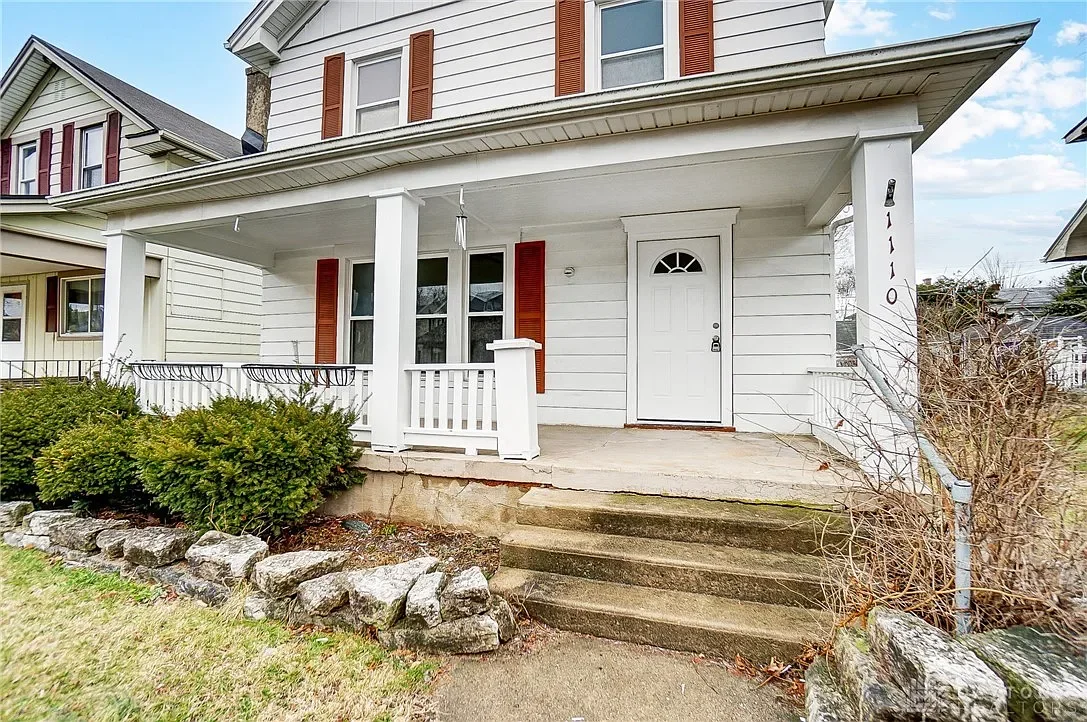
A Dayton house we bought in the condition it was in and renovated after closing. The before-and-after is on our Dayton project write-up.
This guide covers the parts of a PCS home sale that are specific to being in uniform and specific to Ohio: what selling does to your VA entitlement, the tax rule written for people who get orders, what the SCRA actually protects, the disclosure duty Ohio puts on you as a seller, what it costs to close in Montgomery County, and how to sign for a closing from a base two thousand miles away.
The PCS Timeline That Catches Dayton Families Out
The gap between hearing about a move and having to be gone is rarely as long as it feels. Most families get a report date and start working backwards, and the house is the item that does not compress. A traditional listing in this market is not a two-week exercise: you have inspection findings to negotiate, an appraisal to satisfy, and a lender's underwriting clock you do not control.
Our 2026 Dayton market breakdown gets into the submarket detail, but the short version matters here. Move-in ready houses in the stronger school districts move quickly. Houses with 1960s mechanicals, an aging roof, or deferred maintenance take substantially longer, because FHA and VA appraisers flag exactly those things and the buyer's financing stalls while somebody argues about who pays. That is the scenario that turns into a vacant house you are still paying for from your next duty station.
Work backwards from the report date honestly. If the answer is that a normal listing does not fit, it is far better to know that in week one than in week six.
Sell or Rent? The Argument Every PCS Family Has
What Changes the Day You Leave
Your Basic Allowance for Housing follows your duty station, not your mortgage. The moment you PCS, the Dayton payment stops being offset by a Dayton-rate allowance and starts competing with housing costs wherever you land. People routinely plan the rental math on the old BAH and are surprised in month two.
When Renting Genuinely Works
Renting out a Dayton house can be a good decision when the house is in solid condition, the mortgage is comfortably below realistic market rent, and you have either a property manager you trust or family nearby who will actually take the call. It is a business, and it works when you treat it as one.
When It Quietly Does Not
It works less well when the house needs work you were going to get to eventually, when the numbers only clear if the place is never empty, or when the plan depends on you managing a turn remotely between duty days. Our guide to selling a rental property in Dayton covers what tired-landlord math looks like a few years into that, and our vacant house guide covers what happens when the rental plan lapses and the house simply sits — including how City of Dayton abatement costs become a lien on the parcel.
What Selling Actually Does to Your VA Entitlement
This is the single most misunderstood item in a military home sale, and getting it wrong costs you buying power at the next base.
The Clean Path: Pay It Off
If your VA loan is paid in full at closing — which is what happens in an ordinary sale — that is the straightforward route back to your entitlement for the next purchase.
The Path With a Trap: Assumption
A VA-backed loan can be assumed, and in a higher-rate market a low assumable rate is genuinely attractive to buyers. But an assumption is an approved transfer of ownership, and two separate things have to happen for you to walk away clean:
- Release of liability. You are released from further liability on the loan only when the assumption is properly approved and the assumer meets VA's credit underwriting standards. An informal handshake where somebody "takes over payments" releases you from nothing.
- Substitution of entitlement. Your entitlement is only substituted back to you when the purchaser-assumer is an eligible veteran with sufficient entitlement of their own to swap in. A creditworthy civilian can assume your loan, leaving you released from liability but with your entitlement still tied up in a house you no longer own.
Before you agree to an assumption, confirm both points in writing with your loan servicer and your VA Regional Loan Center. This is a five-minute phone call that protects a benefit you may need within the year.
What the SCRA Protects — and What It Does Not
The Servicemembers Civil Relief Act is real protection, but it is narrower than the version that circulates in squadron hallways. Two limits matter to a homeowner:
- The six-percent interest cap applies to obligations incurred before you entered active duty. A mortgage you signed while already serving generally is not covered.
- The foreclosure protection has the same shape. It requires a lender to obtain a court order before foreclosing on a mortgage you took out before entering service, and it runs during your service and for a period afterwards.
Ohio is a judicial foreclosure state in any event, so a lender here goes to court regardless — see our Ohio foreclosure timeline for how that actually runs. Court process is not the same thing as protection; it is only time. If a PCS is about to leave you carrying two housing costs and the mortgage is already tight, deal with it while you still have options, and take the free legal assistance available to you through the base.
The Capital-Gains Rule Written for People Who Get Orders
The ordinary rule is that you must have owned and lived in the home as your main home for at least two of the five years before the sale to exclude gain. Orders break that rule constantly, so there is a provision for it.
IRS Publication 523 allows members of the uniformed services to elect to suspend that five-year test period for up to ten years while on qualified official extended duty. Together, the ten-year suspension and the five-year test period can be as long as — but no longer than — fifteen years. To qualify you generally have to be serving at a duty station at least 50 miles from your main home, or living in government quarters under government orders, under a call to active duty that is indefinite or for a definite period of more than 90 days.
The exclusion itself is up to $250,000 of gain if you file single and up to $500,000 filing jointly. You cannot suspend the period for more than one property at a time. None of this is automatic — it is an election, with conditions, and your specific numbers deserve a tax professional or the installation legal office rather than a blog post.
Ohio's Residential Property Disclosure Form
Ohio Revised Code section 5302.30 requires sellers of most residential property of one to four dwelling units to give the buyer a completed residential property disclosure form, delivered as soon as is practicable. The form asks what you actually know — so if the house has been tenant-occupied and you have not lived in it for three years, you answer to the extent of your actual knowledge rather than guessing.
Two things worth knowing. First, there are statutory exemptions, including transfers ordered by a court and transfers by a fiduciary administering an estate or trust — which is why an inherited property sometimes moves without one. Second, timing has teeth: if the buyer receives the form after signing the purchase contract, they may rescind, and the statute frames that right as three business days from receipt, cut off at the earlier of thirty days after acceptance or the date of closing. A form produced late is a way for a deal to fall apart the week you are trying to out-process.
What It Costs to Close in Montgomery County
Ohio's transaction costs are modest, but they are county-level and people budget them wrong.
| Item | Montgomery County | Who usually pays |
|---|---|---|
| Conveyance fee | $3 per $1,000 of the actual sale price | Customarily the seller |
| Transfer fee | $0.50 per parcel transferred | Customarily the seller |
| Real estate taxes | Billed a year in arrears — prorated at closing | Seller credits the buyer for their period of ownership |
| Agent commission | Negotiated; none on a direct sale | Seller, when listing |
Those conveyance and transfer figures are the Montgomery County Auditor's published amounts. Rates are set locally and differ across the region — if your house is in Greene, Clark or Warren County, confirm the current figure with that county's auditor rather than assuming Montgomery's applies.
The arrears point catches out-of-state sellers most often. Ohio real estate taxes are billed for a period already past, so at closing you are settling up for the time you owned the house, not pre-paying. If there is a delinquency sitting on the parcel it has to come out of the proceeds — our guide on being behind on Dayton property taxes explains how those balances behave.
Closing From Your Next Duty Station
You do not have to be in Ohio to sell a house in Ohio. Closings here run through a title company, and mail-away closings are ordinary. What causes problems is the paperwork nobody arranged before the movers came.
- Sort the power of attorney early. If someone else may need to sign for you, get a property-specific power of attorney drafted through the base legal office. A general military power of attorney is not always accepted for a real estate transfer.
- Get it approved in advance. Lenders and title companies often want to review the power of attorney before closing day, not at the table.
- Keep a notary path. Deeds require notarisation. Confirm what is available at your next installation before you need it.
- Update the mailing address on the parcel. With the county auditor, so tax bills and notices follow you rather than sitting in a mailbox at a house you no longer live in.
Your Four Realistic Options
1. List It Traditionally
The right answer when the house is in good condition, has live utilities, and you have enough runway before your report date. You will usually net the most this way. If that describes your house, we will tell you so.
2. Rent It Out
Workable when the numbers clear at your new BAH rate and you have management in place. Be honest about the condition of the mechanicals before you commit a tenant to them.
3. Assume or Carry It Temporarily
Sometimes the answer is to hold briefly — through the school year, or until a spouse finishes a work commitment. Just cost it out properly, and check your insurance carrier's vacancy terms if the house will be empty at any point.
4. Sell As-Is for Cash
The right answer when the timeline is short, the house needs work an appraiser will flag, or you simply cannot run a listing from another state. Our cash buyer versus realtor comparison lays out the trade-off plainly — you accept a lower gross number in exchange for certainty and speed — and our comparison page puts the three routes side by side.
Selling to Us on PCS Timing
We buy across the Dayton metro, including the communities most Wright-Patterson families live in — see our Fairborn, Beavercreek and Dayton pages, or the full list of areas we serve. On a PCS sale, a few things work differently:
- We close on your date, not ours. Before you clear the installation or after — whichever actually fits the orders.
- No repairs and no appraisal. There is no lender to satisfy, so the roof and the furnace do not have to pass anyone's inspection.
- Nothing has to be emptied. Leave what the movers will not take.
- Remote closing is normal. We work with out-of-state sellers constantly.
- No fees or commissions. We pay the closing costs; the number we agree on is the number you receive.
Our process page sets out the steps and timing, our relocation page covers employer and military relocation sales specifically, and our FAQ page answers the questions we hear most. If listing would net you more and you have the time to do it, we will say so — that is a better outcome for you and it costs us nothing to be straight about it.
PCS Selling Resources
This article is general information about federal benefits and Ohio law, not legal, tax or financial advice, and it is not endorsed by or affiliated with the Department of Defense, the Department of Veterans Affairs or the United States Air Force. Rules and fees change. Confirm anything that affects a decision with your loan servicer, your VA Regional Loan Center, a tax professional, the Montgomery County Auditor, or the legal assistance office at your installation.